
Building remediation projects in Australia fail before construction begins because the scope is built on assumptions rather than invasive diagnostics, budgets exclude contingency for hidden defects, contracts don’t account for latent conditions, strata governance delays decisions, and NCC compliance pathways remain unresolved. These failures trigger scope creep, cost blowouts, and abandoned projects before trades mobilise.
Tau Constructions has delivered remediation works across Sydney for 20+ years. Projects investing in pre-construction planning are completed on time and budget, while those rushing to tender without diagnostic proof stall within weeks.
The Real Reason Projects Fail
Projects fail 6-8 weeks before construction when inadequate investigation meets optimistic budgeting, vague contracts, and disconnected decision-making. The pre-construction phase establishes whether you’re managing knowable risks or absorbing costly surprises.
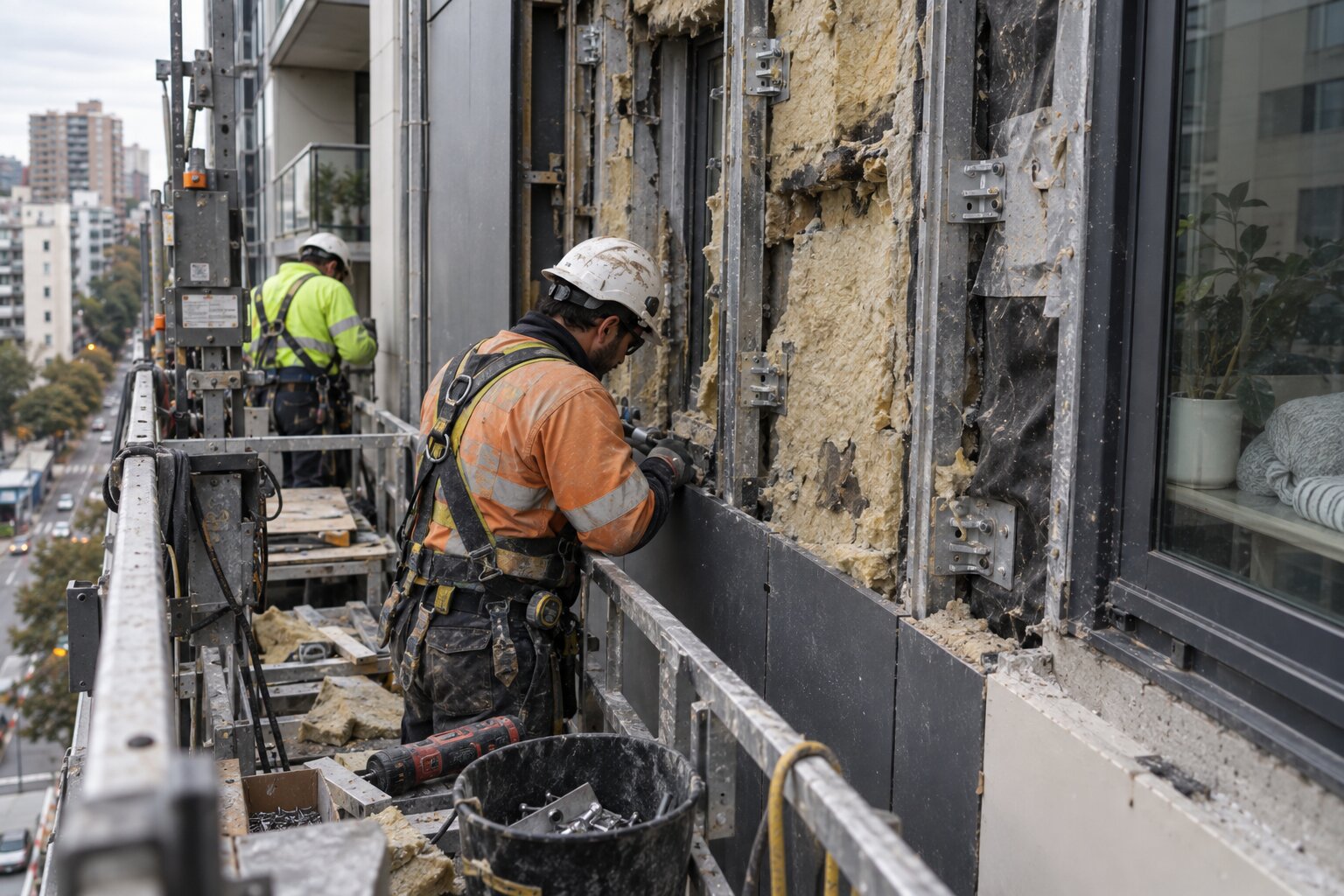
Consider a Sydney strata building with suspected water ingress. Surface inspections identify cracked tiles and damp patches. Tender documents describe “waterproofing repairs to balconies.” Three contractors quote $180,000 to $340,000. The owners’ corporation selects the lowest bid. Invasive demolition reveals failed membranes, corroded structural steel, and concealed drainage defects. The actual scope triples. Funding gaps emerge. The project stalls. This repeats across commercial, multi-residential, and heritage buildings because pre-construction investigation was insufficient.
Inadequate Investigation Creates Invisible Scope
Surface-level inspections miss underlying structural, waterproofing, and compliance issues that arise during construction, leading to a 40-60% scope expansion. Remediation requires invasive testing, not visual assessment, to quantify defects accurately. Ground-penetrating radar, moisture mapping, core sampling, and prototype bay openings provide evidence-based scope definition.
Tau Constructions conducts comprehensive investigation protocols before preparing scope documentation: opening wall cavities, testing membrane integrity, extracting core samples for laboratory analysis, and documenting findings with photographic evidence. A $25,000-$40,000 investigation investment prevents $200,000-$500,000 in mid-construction variations. Investigation also identifies whether defects trigger DBP Act obligations, require NCC performance solutions, or demand specialist engineering input.
Investigation must produce quantified deliverables: measured areas requiring remediation, material specifications, access methodology, waste volumes, and compliance pathways. These become the basis for bills of quantities that contractors price accurately. Projects skipping invasive testing discover true scope after mobilisation, when costs escalate, and timelines collapse.
Budget Fiction Without Contingency or Escalation
Remediation budgets built on an incomplete scope and zero contingency fail within the first variation, as owners’ corporations discover real costs exceed approved special levies by 40-80%. Quantity surveyors specialising in remediation understand that 15-25% contingency is standard because latent conditions are inevitable. Projects also require escalation allowances for material lead times extending 8-16 weeks for non-combustible cladding, waterproofing membranes, and structural steel.
The “low-ball tender trap” compounds budget failure. Contractors submitting significantly lower quotes often exclude preliminaries, underestimate labour productivity on occupied sites, or plan to recover margin through variations. Strata committees selecting the cheapest quotes without technical evaluation discover contractors lack remediation-specific experience, abandon projects mid-delivery, or trigger disputes requiring legal resolution.
Tau Constructions provides transparent cost modelling: scope-specific productivity rates, accurate preliminaries for live environment delivery, contingency aligned to investigation findings, and escalation indexed to procurement lead times. This establishes realistic funding targets and prevents special levy shortfalls that stall projects.
Contract and Scope Ambiguity Enable Variation Proliferation
Inappropriate contract types and vague scope documentation create variation-prone agreements where contractors legitimately claim additional costs for every latent condition discovered. Remediation requires contracts explicitly addressing discovery protocols, variation thresholds, and latent condition mechanisms. Standard construction contracts designed for new builds don’t accommodate remediation’s investigative, adaptive nature.
AS 4000 contracts modified with robust latent conditions clauses provide frameworks when paired with detailed method statements, access plans, temporary works requirements, and make-good specifications. Scope documents stating “remove and replace defective waterproofing” invite disputes. Documents stating “remove existing membrane system to structural substrate, prepare surface to AS 3740 standards, install two-part polyurethane membrane with 150mm upturns, integrate with building drainage, test to AS 4654.1, reinstate tiling to match existing” enable accurate pricing and reduce variation potential.
Tau Constructions develops variation-proof scope documentation before tender, including appointing remediation-experienced superintendents who administer contracts, assess latent conditions against predefined thresholds, and maintain transparent communication throughout delivery.
Stakeholder Governance Breakdown in Strata Environments
Owners’ corporation decision timelines, voting requirements, and communication gaps delay critical approvals, preventing project commencement despite contractor availability. Remediation projects serving multi-owner buildings require special resolutions, transparent cost reporting, regular updates, and consent management across dozens of stakeholders. Without structured governance calendars and decision gates, projects drift through months of committee indecision.
Successful remediation requires governance frameworks before tender: meeting cadences, communication protocols, decision authorities, voting schedules, and escalation pathways. Strata managers coordinating these elements alongside remediation-specialist project managers maintain momentum through investigation, design, approval, tender, and delivery phases.
Tau’s director-led model ensures accountability and continuity throughout stakeholder engagement through transparent progress reporting, risk dashboards, and proactive communication. This prevents stakeholder misalignment that stalls projects after funding approval but before contract execution.
Regulatory and Compliance Gridlock
NCC performance solutions, fire engineer sign-offs, certifier endorsements, and authority approvals remaining unresolved at tender cause 6-12 week delays when contractors cannot lawfully commence. Remediation often triggers performance solution pathways for facade systems, fire compartmentation, and accessibility compliance. These regulatory processes require specialist consultant input and documentation preparation extending 8-16 weeks when initiated reactively.
Combustible cladding replacement requires NCC compliance verification, fire engineer performance solutions, certifier approval, and sometimes council consent. Waterproofing remediation affecting Class 2 buildings triggers the DBP Act obligations requiring registered practitioners to certify compliance. Structural remediation may require additional engineering certification under AS standards.
Tau Constructions initiates compliance pathways during investigation, not after tender award. We engage fire engineers, building surveyors, and certifiers early to map approval requirements, prepare submission documentation, and secure regulatory sign-offs before contractor mobilisation. This eliminates compliance gridlock, preventing construction commencement.
How Tau Constructions Prevents Pre-Construction Failure
Tau Constructions delivers remediation through a diagnostic-first methodology, eliminating pre-construction failure modes. Our process begins with comprehensive invasive testing, quantifying the scope accurately. We develop bills of quantities with realistic productivity rates, appropriate contingency, and material escalation allowances. Our contracts include explicit latent condition protocols administered by remediation-experienced superintendents.
We establish governance frameworks, maintaining stakeholder alignment through investigation, design, approval, and tender phases. Our director-led team initiates NCC compliance pathways, fire engineer coordination, and certifier engagement before tender release. This approach has enabled Tau to complete remediation projects across commercial, residential, and heritage sectors without budget blowouts, scope disputes, or regulatory delays.
For building owners evaluating remediation contractors, the pre-construction phase reveals capability. Contractors investing in investigation, developing transparent cost models, and demonstrating regulatory coordination prevent failure before site establishment.
Building Remediation That Starts Right
Pre-construction rigour determines remediation success. Projects investing in diagnostic testing, realistic budgeting, appropriate contracts, and regulatory coordination are completed on time and on budget. Those rushing to tender without investigation experience scope creep, funding gaps, and approval delays, characterising pre-construction failure.
Tau Constructions applies 20+ years of remediation expertise, preventing these failure modes through director-led investigation, transparent cost modelling, and proactive coordination.
Explore our building remediation services to understand how Tau’s investigation-led approach prevents pre-construction failures from derailing remediation projects across Australia.