
Section 37 of the Design and Building Practitioners Act 2020 imposes a non-delegable, non-contractable statutory duty of care on every person who carries out construction work, owed to current and every subsequent owner of the land for ten years from the Occupation Certificate.
The Pafburn High Court decision in December 2024 confirmed that proportionate liability defences are not available under Section 37, head contractors and developers carry vicarious liability for their subcontractors. Class 2 head contract structure must reflect this reality before execution. Tau Constructions delivers Class 2 residential construction under NSW Licence 321977C as a registered Building Practitioner.
Why Section 37 changed Class 2 head contract structure for NSW developers
Section 37 reshaped the economics of NSW Class 2 development. Before the DBP Act commenced on 1 July 2021, builder selection on a Class 2 project was primarily a price and capability decision. After Section 37, builder selection is a liability-sharing decision.
The duty under Section 37 cannot be delegated under Section 39, and cannot be contracted out under Section 40. No clause in any head contract, sub-contract, or consultant appointment can limit the duty owed to current and subsequent owners. The duty extends ten years from the Occupation Certificate. Section 41 confirms it operates alongside Home Building Act warranties and common law duties, not in place of them.
A solvent-registered Building Practitioner now represents genuine recourse where a phoenix entity does not.
What Section 37 actually says, and why the wording matters before contract execution
Section 37(1) provides that a person who carries out construction work has a duty to exercise reasonable care to avoid economic loss caused by defects in or related to a building for which the work is done and arising from the construction work. Section 37(2) extends the duty to each owner of the land and to each subsequent owner.
The “construction work” definition is broader than most developers assume
“Construction work” is defined in Section 36(1) to include building work, the preparation of regulated designs, the manufacture or supply of building products, and supervising, coordinating, project managing, or otherwise having substantive control over the carrying out of any of those activities.
That last limb, substantive control, extends Section 37 exposure beyond the contracting builder to anyone with the ability to control how construction work is performed. Tau Constructions has previously published a developer guide on the DBP Act and Class 2 obligations covering the regulated design and lodgement framework that sits alongside Section 37.
How the Pafburn decision changed developer and head contractor vicarious liability
In Pafburn Pty Ltd v The Owners – Strata Plan No 84674 [2024] HCA 49, the High Court determined that neither the developer nor the head contractor could rely on the proportionate liability regime in Part 4 of the Civil Liability Act 2002 to limit their exposure under Section 37.
Non-delegation and vicarious liability for subcontractors
The High Court held that the duty is non-delegable, and that developers and head contractors are vicariously liable for the negligence of subcontractors they engage to perform tasks covered by the duty. A head contractor does not discharge its Section 37 duty by exercising reasonable care in the selection of skilled subcontractors. A developer does not discharge its duty by exercising reasonable care in the selection of the head contractor.
What the ruling means for owners’ corporation claims
The practical consequence is that an owner’s corporation can now bring a single claim against a developer or head contractor for the entire economic loss arising from defects, and the defendant carries both the cost of any cross-claim against subcontractors and the insolvency risk of those subcontractors.
When a developer “carries out construction work” under the substantive control test
In The Owners – Strata Plan No 84674 v Pafburn Pty Ltd [2022] NSWSC 659, the Supreme Court found that a developer who is “in a position where it can control how construction work is carried out” may have substantive control within the meaning of Section 36(1)(d). The developer does not need to have actually exercised that control. The ability to control is sufficient.
A developer who retains the ability to direct how work is performed, through head contract clauses reserving direction rights, through retained nominated subcontractor selection, through retained design approval rights, or through close on-site involvement, may be found to have carried out construction work and may therefore owe the Section 37 duty in addition to the head contractor.
In Kazzi v KR Properties Global Pty Ltd t/as AK Properties Group [2024] NSWCA 143, the Court of Appeal confirmed personal liability of individuals under Section 37. Directors of a corporate developer who supervise, coordinate, project manage, or have substantive control over construction work can be sued personally under the Act.
What clauses must appear in a Class 2 head contract to protect developer position
Section 40 voids any contract clause attempting to limit or exclude the Section 37 duty. The clauses that survive Section 40, and the clauses that must appear in a Class 2 head contract, fall into five categories.
DBP Act compliance clauses
These clauses require the head contractor to lodge regulated designs, design compliance declarations, and the building compliance declaration on the NSW Planning Portal in accordance with the Act, with at least 14 days’ written notice before any application for the Occupation Certificate.
Registered practitioner verification clauses
These clauses require the head contractor to confirm that all design and building practitioners engaged on the project are properly registered for the matters to which their declarations relate.
Insurance clauses
These clauses require professional indemnity coverage that specifically addresses Section 37 risks, with the head contractor obliged to maintain that coverage for the full ten-year limitation period.
Indemnity clauses
These clauses require the head contractor to indemnify the developer for any breach of Section 37 by the head contractor or its subcontractors. Indemnities are enforceable as between the parties even though they cannot reduce the head contractor’s primary duty to owners.
Defect notification and rectification clauses
These clauses set strict timelines for the head contractor to identify and rectify defects before the Occupation Certificate application, supporting the building compliance declaration the head contractor must lodge.
Tau Constructions delivers Class 2 residential construction under NSW Licence 321977C within this contract framework.
Why registered Building Practitioner selection is now a liability-sharing decision
Under Section 17, only a registered Building Practitioner can lodge a building compliance declaration. The Building Practitioner’s registration must authorise the matters declared. Section 24 requires the practitioner to maintain insurance complying with the regulations against any liability that may arise from providing the declaration or carrying out the work.
After Pafburn, the head contractor’s solvency over a ten-year horizon is the developer’s exposure horizon. A head contractor that cannot maintain insurance, cannot maintain registration, or cannot maintain operational continuity through the ten-year limitation period is a developer-side liability concentration risk.
Tau Constructions operates under NSW Licence 321977C as a registered Building Practitioner, with ISO-aligned systems and published Subcontractor Claims and Supply Chain Prequalification governance. The Pafburn ruling that developers and head contractors are vicariously liable for subcontractors makes subcontractor governance a material due diligence item during builder selection.
Tau’s construction management for Class 2 head contract delivery addresses the operational continuity, subcontractor governance, and registered practitioner discipline that Section 37 exposure now demands.
How Early Contractor Involvement reduces Section 37 evidentiary exposure
Section 37 claims are pleaded by reference to specific defects, and breach must be established with precision. The evidence base for a Section 37 defence is the documentation produced during design and construction, regulated designs, design compliance declarations, variation declarations, performance solution records, and the building compliance declaration.
ECI engagement at the concept-design stage allows the head contractor to scrutinise constructability, lock performance solution choices before regulated design lodgement, and structure the documentation discipline that the ten-year defence horizon requires. Variations to building elements and performance solutions during construction trigger new declarations within one day, or construction of that element must stop until the documentation is lodged. ECI reduces the variation declaration frequency, which compresses construction programs and weakens documentation continuity.
Tau Constructions delivers Early Contractor Involvement for Class 2 developers under DBP Act compliance from concept-design through to Occupation Certificate.
Section 37 retrospective scope and exposure on existing Class 2 assets
Schedule 1 clause 5 of the DBP Act applies Section 37 retrospectively to construction work carried out from June 2010 onwards, where the economic loss first became apparent within the ten years immediately before commencement of Section 37 or first becomes apparent on or after commencement.
This retrospective operation has produced a substantial volume of post-2021 strata claims against builders, designers, and consultants responsible for Class 2 buildings completed in the decade before the Act commenced.
Developers acquiring or holding existing Class 2 assets carry Section 37 exposure on prior construction work, including non-compliant cladding, defective waterproofing, and structural defects that emerged within the retrospective window.
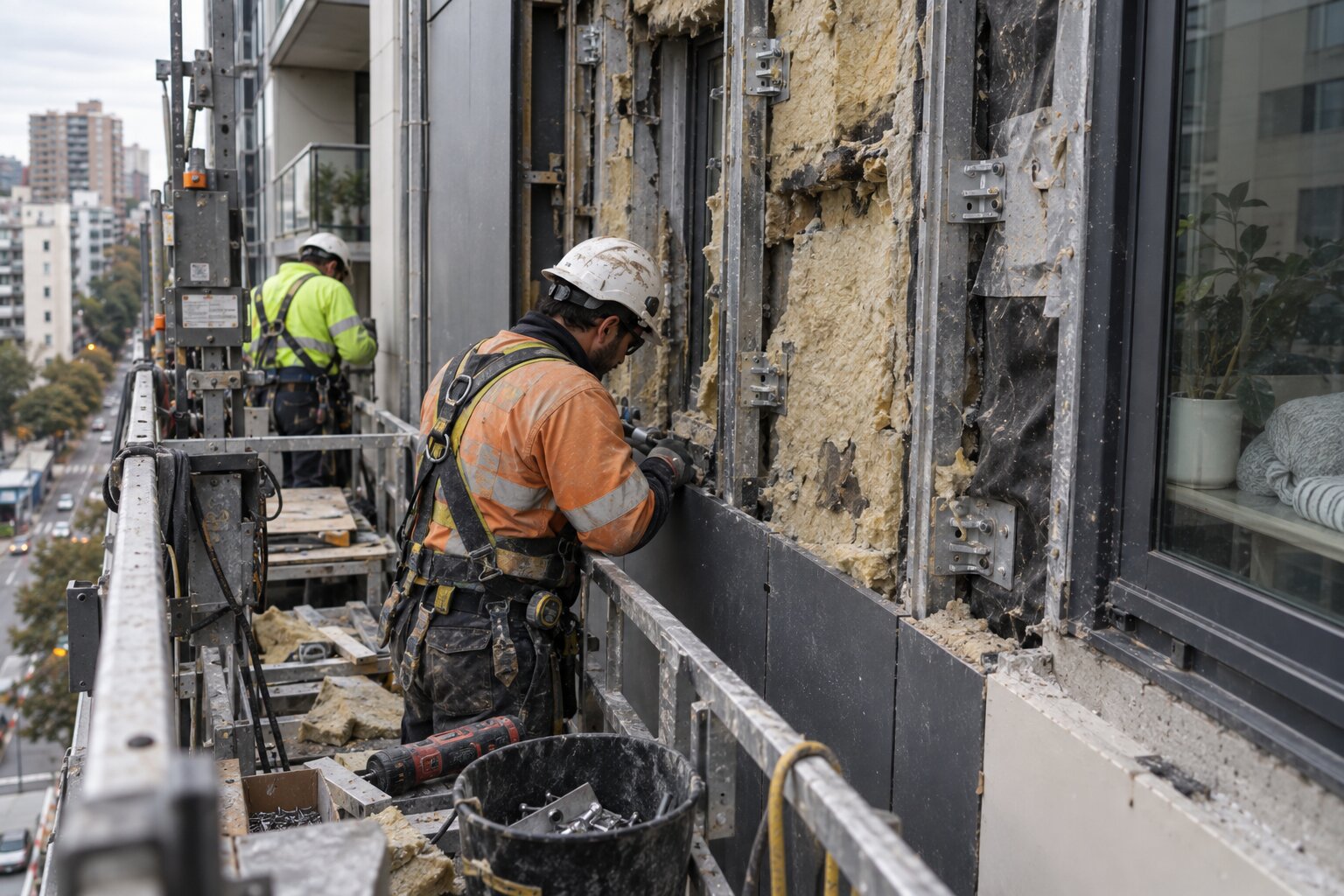
Tau Constructions deliver building remediation under Section 37 retrospective scope, including combustible cladding replacement and structural rectification on existing Class 2 assets.
Director personal liability under Section 37, what corporate developers must understand
The Kazzi decision confirmed that directors of a corporate developer or builder can be sued personally under Section 37 if they had substantive control over how the construction work was carried out. Section 28 of the DBP Act separately requires each director of a registered body corporate to ensure compliance with the Act, that appropriate management systems are in place, and that compliance declarations are issued by individuals whose registration authorises them.
Directors of corporate developers who retain decision-making power on construction matters, who supervise progress and manner of works, or who direct subcontractor engagement may meet the substantive control threshold under Section 36(1)(d). The Section 37 duty would then attach personally, alongside the corporate developer’s duty.
This is the structural argument for director-led delivery on the head contractor side. Tau Constructions structures delivery around a senior team that engages across the full project lifecycle, Nicholas Economos as Director, supported by Ari Kammas, Chandan Patil, Aichlinn Trainor, and Aaron James Moreno, so that the registered Building Practitioner accountability under Section 37 is held by a Director who carries the personal exposure that the Act creates, and who is structurally aligned to discharge it.
What this means before signing the head contract
Section 37 reshapes the head contract structure and builder selection for NSW Class 2 developers under a non-delegable, non-contractable statutory duty owed to current and future owners for ten years from the Occupation Certificate, with vicarious liability for subcontractors confirmed by Pafburn.
Builder selection is now a ten-year liability-sharing decision. Head contract clauses must address DBP Act compliance, verification of registered practitioners, insurance maintained for the full limitation period, and indemnity that survives between the parties. ECI engagement before regulated design lock reduces evidentiary exposure during the defence horizon. Existing Class 2 assets carry retrospective Section 37 exposure that remediation work must address.
Tau Constructions delivers Class 2 residential construction under NSW Licence 321977C as a registered Building Practitioner, with director-led delivery aligning structural accountability to Section 37 exposure. Bring us the contract structure, and we’ll bring the registered practitioner discipline. Contact the Tau team to discuss your Class 2 project at the planning, Early Contractor Involvement for Class 2 developers, or construction management stage.
Tau Constructions: Tier 1 standards, boutique attention, director-led delivery.
This article provides general information about Class 2 construction delivery under the DBP Act and is not legal advice. NSW developers should obtain independent legal advice on the specific head contract structure and Section 37 exposure.