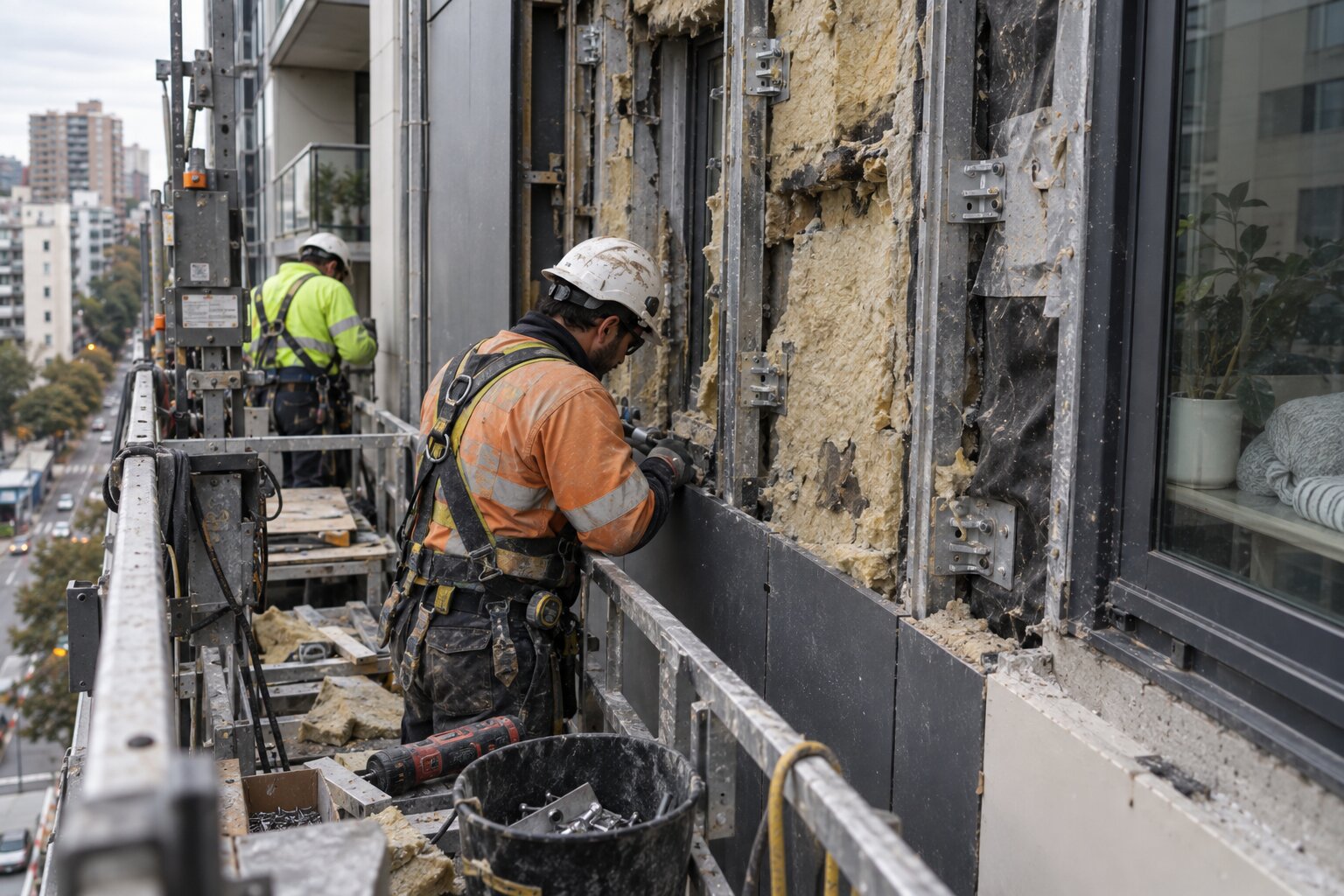
Combustible and non-compliant cladding is replaced when the material itself fails current fire safety requirements, regardless of how the panels look. Repair applies only once that material is confirmed compliant and any remaining defect stays contained to a limited area. A performance solution, an engineered alternative that adds fire safety measures instead of removing the material, resolves some cases without physical replacement at all.
Tau Constructions has replaced non-compliant facade cladding across three completed Sydney projects, applying the same compliance-first assessment each time before deciding whether repair, replacement or an engineered alternative applies. Facade and cladding remediation of this kind starts with confirming what the material actually is, not how it looks.
Compliance vs Condition
The decision runs on two separate questions, not one severity scale. The first question has nothing to do with how the cladding looks.
Compliance
Compliance asks whether the material itself is non-compliant: an aluminium composite panel with a combustible core, an expanded polystyrene render system, or an equivalent product. A repair does not change what the material is made from, so non-compliant material is replaced regardless of its physical condition.
Replacing only the visible panel does not guarantee compliance either, since the whole external wall system, insulation, cavity and fixings included, has to meet the standard together. This is usually identified through an audit finding, a formal notice, or an insurer requirement.
Condition
Condition only matters once the material passes the compliance question above. From there, the extent of the physical defect decides the pathway.
- Repair applies when the defect is contained: a failed seal, localised water ingress, isolated impact damage, and the wider system remains sound
- Replacement can still apply, even on compliant material, when defects are widespread or systemic across multiple elevations, since staged repair then costs more than a single replacement programme
The Performance Solution Pathway
A performance solution is an engineered alternative to physical replacement: a fire safety engineer demonstrates an equivalent safety outcome through other measures, extra egress, sprinkler upgrades, active fire safety systems, rather than removing the existing material.
The pathway is not a cheap shortcut. A facade engineer’s substrate investigation and a fire safety engineer’s feasibility report can run into the tens of thousands of dollars before any decision is reached, approval can take several months, and insurance support for the pathway needs confirming before committing to it, since insurer backing is not automatic.
It tends to make more sense where physical replacement carries disproportionate cost or disruption, a heritage facade or a fully occupied building being staged around, rather than as a general alternative to replacement. The added fire safety measures also carry their own ongoing certification and inspection obligations once installed.
Substructure Risks During Cladding Removal
Removing cladding exposes the substructure, and what is found behind it sometimes changes the job’s scope and cost. Water damage, rot, or undersized insulation are common findings once panels come off, common enough across cladding rectification work to expect rather than treat as a rare exception.
A substructure or facade investigation before a replacement scope and price are finalised prices this risk in advance instead of leaving it to surface mid-project, the difference between a fixed scope that holds and a variation that appears once the wall is already open.
Completed Cladding Replacement Projects by Tau Constructions
Three completed projects show what non-compliant cladding replacement involves in practice, across three different Sydney addresses rather than a single job.
| Project | Value | Scope |
| Hampden St, Cremorne | $850,000 | Removal and replacement of non-compliant facade cladding |
| Bruce St, Brighton | $1,400,000 | Removal and replacement of non-compliant facade cladding |
| Marine Pde, Maroubra | $1,200,000 | Removal and replacement of non-compliant facade cladding |
Each involved full removal of the existing panels rather than a partial or staged approach, since the material itself was the trigger rather than a contained defect, consistent with the compliance question above taking priority over how the panels looked. Each project also had to be sequenced around residents or tenants remaining in place during the works, a live-environment consideration as much as a compliance one.
Cladding Rectification Decision-Makers
On an existing building, this decision usually sits with an owners corporation, a strata committee or an asset manager, not a single individual, and it typically starts with an audit finding, an insurer requirement or a building condition report identifying the material as non-compliant.
That process is a design decision under NSW law before it is a construction one. Cladding rectification design work on a Class 2 building requires a registered design practitioner to prepare the designs under the Design and Building Practitioners Act.
The cost of whichever pathway follows is typically shared across all lot owners in a strata scheme, which is why the decision usually goes through a formal owners corporation resolution rather than being settled informally.
Cladding Compliance Assessments
The material question decides the pathway before the damage question does, and confirming it early protects the budget and the programme either way. Tau Constructions has replaced non-compliant facade cladding across three Sydney projects under director-led oversight, from the first compliance assessment through to completion.
Talk to Tau about a cladding compliance assessment.
Cladding Replacement and Repair FAQs
Is repair ever appropriate for non-compliant cladding?
No, not on its own. A repair does not change the material’s compliance status. Repair applies only once the material is confirmed compliant and the remaining defect is contained.
What standard must replacement cladding meet?
Non-combustible replacement material must be tested to AS 1530.1. Common compliant alternatives include solid aluminium panels, mineral-core panels, fibre cement, brick and terracotta.
Is ACM cladding banned in Australia?
Aluminium composite panel with a combustible core is restricted on many building types, with the specific restrictions and exceptions varying by building class and height. Current status should be confirmed for a specific building rather than assumed as a blanket rule.
What can non-compliant cladding be replaced with?
Certified non-combustible materials tested to the relevant Australian Standard, commonly solid aluminium, mineral-core panels, fibre cement, brick or terracotta, selected to suit the building’s design and performance requirements.
Should cladding be a concern when buying a property?
Yes, on any building with an external cladding system installed before current standards tightened. A cladding-specific check as part of due diligence can identify a non-compliance issue before it becomes the buyer’s problem.