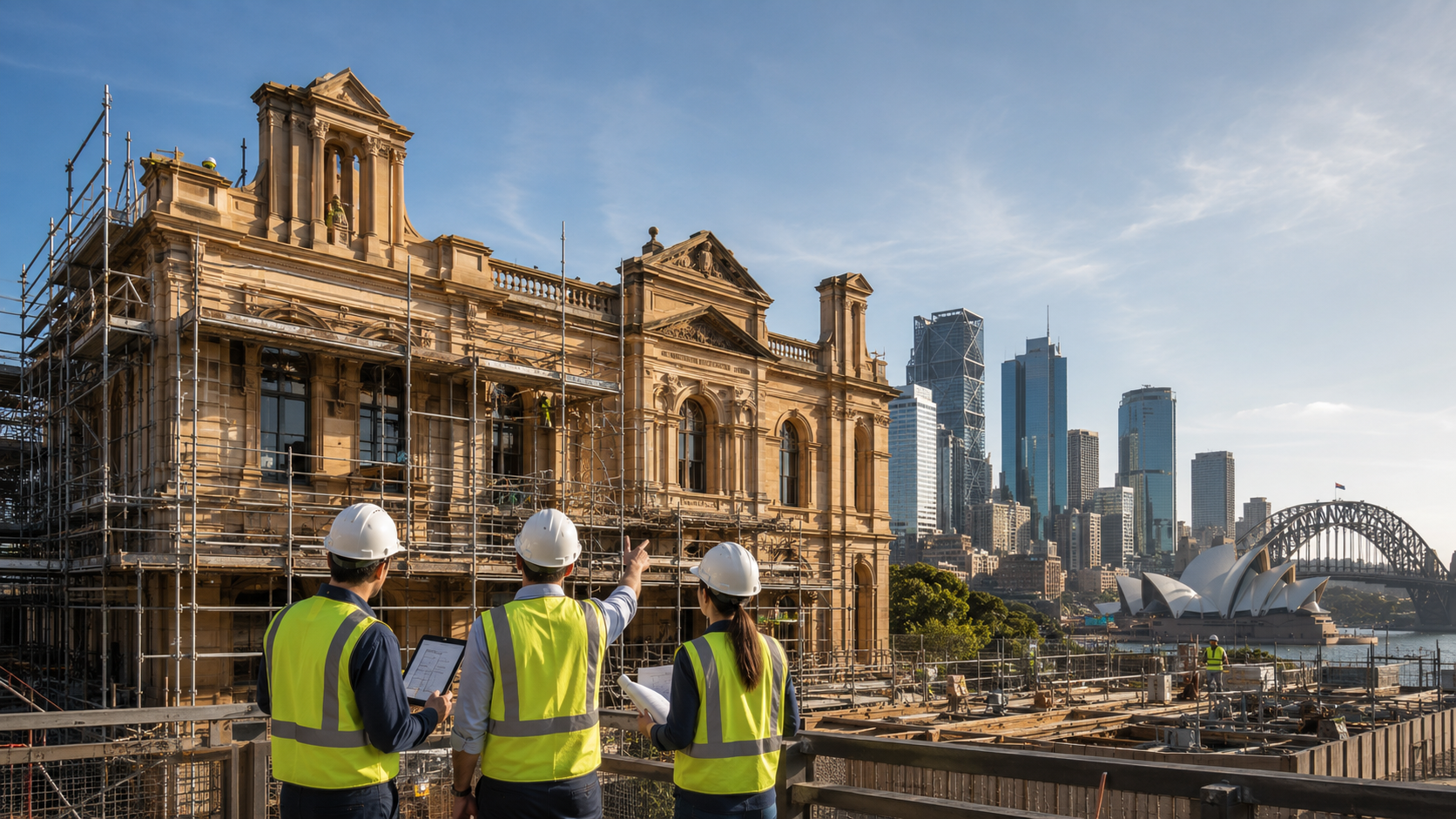
Heritage building restoration in Sydney operates under two regulatory frameworks running in parallel: the NSW Heritage Act 1977, governing heritage fabric retention, and the Design and Building Practitioners Act 2020, governing regulated construction work on Class 2 and Class 3 heritage buildings.
The intersection requires NCC Performance Solutions, where Deemed-to-Satisfy compliance would compromise historic fabric, registered Design Practitioner and Building Practitioner coordination, and Conservation Management Plan integration with construction documentation.
Tau Constructions delivers heritage integration work across Sydney CBD and Surry Hills, including the Ace Hotel Sydney 18-level, 264-room project, where heritage context is integrated with new construction at Tier 1 hotel scale, delivered under NSW Licence 321977C with Director Nicholas Economos involved end-to-end.
What Makes Heritage Building Restoration Different From Standard Construction
Heritage restoration carries obligations that standard commercial construction does not. The work runs under three structural constraints that shape every project.
Heritage fabric retention sits at the centre of the work. The NSW Heritage Act 1977 prohibits unauthorised alteration, damage, or demolition of State Heritage Register items, and local council Heritage Conservation Areas extend similar controls to locally significant buildings.
Specialist trades carry the work, stonemasonry, traditional joinery, lime mortar repointing, plastering, and ornamental detail reproduction. Material specification follows like-for-like principles, with replacement materials matching the original fabric where reasonably possible.
Decisions on heritage projects carry irreversibility that standard construction does not. A demolished cornice cannot be put back. A drilled sandstone façade cannot be undrilled. The work requires senior judgment at decision points and documentation discipline through delivery.
NSW Heritage Act 1977 and the Heritage Council Approval Pathway
The NSW Heritage Act 1977 is the primary legislation protecting heritage in NSW. The Act establishes the State Heritage Register and the Heritage Council of NSW, and governs alteration, repair, demolition, and adaptive reuse work on listed items.
Section 60 of the Act covers the works approval pathway for State Heritage Register items. The Section 60 application requires a Heritage Impact Statement (HIS) outlining the proposed work’s effect on heritage significance. For State-listed items with major impact, advertising extends the assessment timeframe to approximately 60 days. Lower-impact works follow a fast-track pathway of 21 days once accepted as complete.
Local Environmental Plans (LEPs) govern locally listed heritage items and Heritage Conservation Areas. Local councils manage approvals for locally significant heritage. Minor works on locally listed buildings may qualify for written notification rather than full development consent, subject to the relevant LEP clauses.
The Heritage Regulation 2012 sets Minimum Standards of Maintenance and Repair for State Heritage Register items, requiring weatherproof, structurally sound, fire-protected, and secure buildings. The Burra Charter (Australia ICOMOS Charter for Places of Cultural Significance) provides the conservation framework that consultants and certifiers apply across heritage decisions.
Preservation vs Adaptive Reuse: The Structural Decision for Heritage Assets
Heritage assets in Sydney follow one of two pathways at the strategic decision stage.
Preservation retains the building in its current use with intervention limited to maintenance, repair, and minimal alteration. The pathway suits buildings where the existing use remains viable, and heritage fabric requires stabilisation rather than reconfiguration.
Adaptive reuse converts the heritage building to a new use while retaining significant fabric. Sydney’s commercial property market has delivered adaptive reuse projects across hospitality, residential, office, and cultural categories, sandstone civic buildings converted to luxury hotels, industrial warehouses converted to commercial venues, heritage terraces converted to mixed-use developments.
The pathway decision shapes the entire project. Programme duration, regulatory pathway, construction scope, and cost structure all differ between preservation and adaptive reuse. The decision sits with the developer or asset owner, supported by heritage consultant and registered Building Practitioner input at feasibility. Commercial refurbishment under heritage compliance typically operates within the adaptive reuse pathway.
Heritage Fabric Retention Under Modern Compliance Obligations
Heritage buildings predate current building codes. Modern compliance requirements, fire safety, accessibility, energy efficiency, and structural performance apply to alteration and adaptive reuse work, but strict Deemed-to-Satisfy compliance can compromise heritage fabric.
NCC Performance Solutions provides the regulatory pathway. The NCC allows performance-based compliance where the building demonstrably achieves the required performance outcome without following the Deemed-to-Satisfy methodology. Heritage-experienced building certifiers and fire engineers prepare Performance Solutions tailored to heritage fabric, achieving safety outcomes without removing or substantially altering historic features.
The Design and Building Practitioners Act 2020 layers regulated work obligations on top. Class 2 heritage buildings and Class 3 heritage buildings (hotels, boarding houses, backpackers’ accommodation) sit within the DBP Act-regulated framework. Registered Design Practitioners prepare regulated designs across architectural, structural, façade, fire safety, and services disciplines for heritage work.
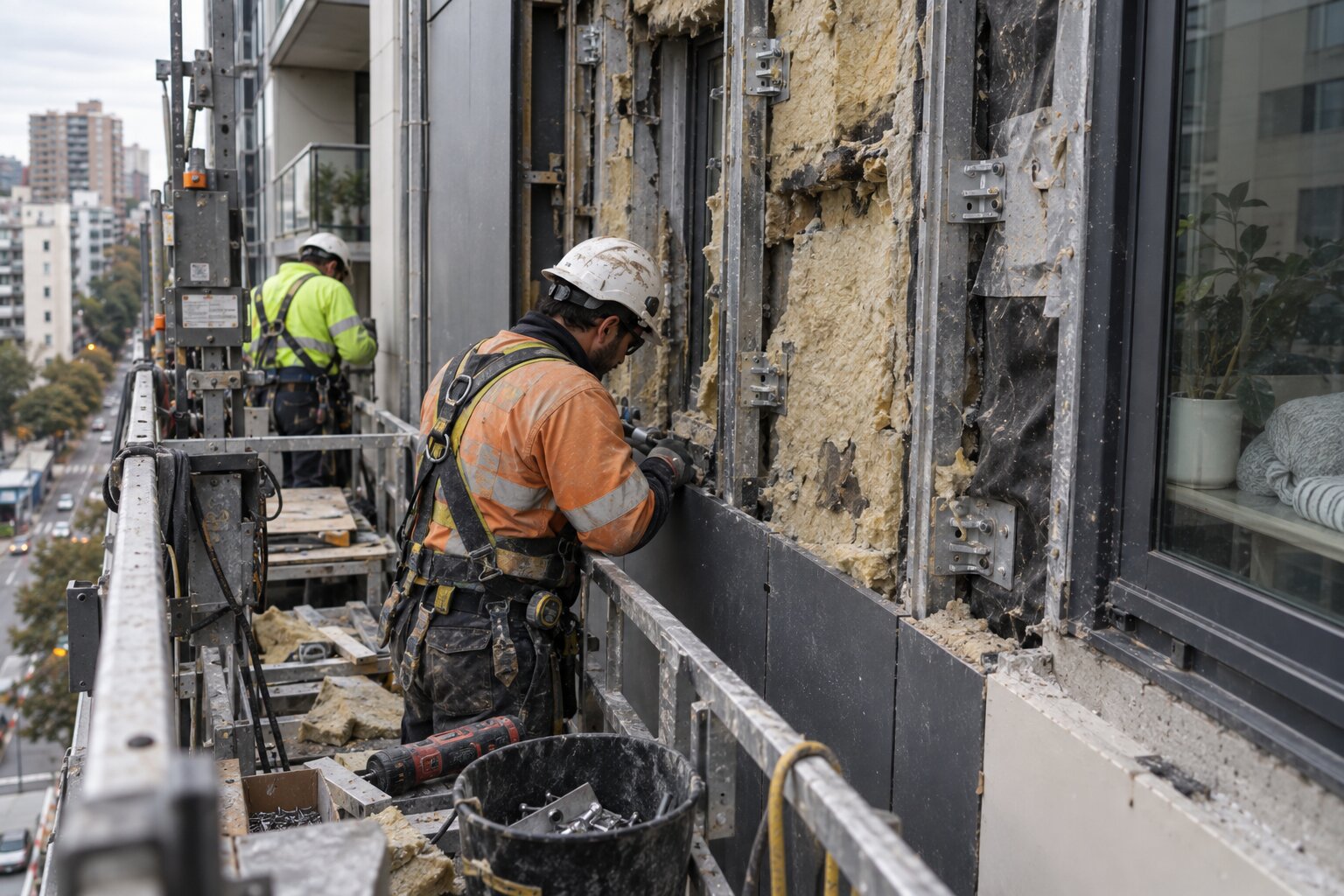
The registered Building Practitioner lodges the building compliance declaration covering the entire build, including heritage scope. Where combustible cladding remediation overlaps with heritage façade work, Tau Constructions has delivered Combustible Cladding Projects under DBP Act-regulated work on Class 2 heritage buildings.
From 1 July 2026, alteration and renovation work on existing Class 3 buildings comes within the DBP Act. Hotel developers planning heritage hospitality conversions across the second half of 2026 must verify scope against the expanded obligations before contract execution.
Ace Hotel Sydney Surry Hills: Heritage Integration at Hotel Scale
Ace Hotel Sydney sits in Surry Hills as an 18-level, 264-room, 5-star hotel delivered by Tau Constructions. The Surry Hills location carries a dense heritage context, and the project integrated heritage considerations across the construction programme at Tier 1 hotel scale.
The structural difference between commodity heritage restoration and Tau’s Ace Hotel delivery lies in the scale and coordination depth. Most Sydney heritage restoration operates at the single-building, specialist-trades scale, stonemasonry on a Federation terrace, lime mortar repointing on a sandstone church, timber joinery on a Victorian shopfront.
Tau’s Ace Hotel scope carried that craft discipline alongside 18-level new construction integration, 264 hotel rooms requiring DBP Act-regulated design coordination, and Class 3 building compliance under NCC Volume One.
The Kiln Restaurant on Level 18 and Ace Hotel Lobby & Bar at ground level extended the heritage context into a specialty venue scope. Both venues required hotel fitout and hospitality construction in Sydney, delivery discipline integrating heritage building context with current hospitality brand standards.
Why Director-Led Delivery Matters on Heritage Projects
Heritage decisions are irreversible. Demolished fabric cannot be reinstated. Damaged sandstone cannot be undamaged. Compromised joinery cannot be unmade. The decision quality at heritage assessment, design, and execution stages carries through the building’s remaining lifespan.
Senior judgment at decision points addresses three project risks specific to heritage work. Trade coordination requires technical authority where stonemasons, joiners, plasterers, and modern services trades work in the same fabric. Approval pathway navigation requires an understanding of Section 60 works approvals, Heritage Impact Statement preparation, and Heritage Council expectations. DBP Act declaration discipline requires the registered Building Practitioner within the documentation chain across the heritage scope.
Director-led delivery on heritage projects places Nicholas Economos directly inside the assessment and execution decision chain. The same senior judgment that shapes heritage approach at feasibility carries the project through handover, supporting documentation continuity across the heritage and modern compliance frameworks.
Frequently Asked Questions
Do you need approval to restore a heritage building in NSW?
Yes. State Heritage Register items require Heritage Council of NSW approval under Section 60 of the Heritage Act 1977. Locally listed heritage items and properties within Heritage Conservation Areas require local council approval. Minor maintenance work may qualify for exempt or complying development pathways depending on the relevant Local Environmental Plan.
What is a Heritage Impact Statement?
A Heritage Impact Statement (HIS) documents the proposed work’s effect on heritage significance. The HIS accompanies the development application and supports the Heritage Council or local council assessment of the proposed alteration, repair, or adaptive reuse work.
Does the DBP Act apply to heritage building restoration?
Yes, where the heritage building is a Class 2 (multi-unit residential) or Class 3 (hotel, boarding house, backpackers’ accommodation) building. Class 2 heritage buildings have been regulated under the DBP Act since 1 July 2021. From 1 July 2026, alteration and renovation work on existing Class 3 heritage buildings also falls within scope.
What is the difference between preservation and adaptive reuse?
Preservation retains the building in its current use with intervention limited to maintenance, repair, and minimal alteration. Adaptive reuse converts the heritage building to a new use while retaining significant heritage fabric. The pathway decision shapes the programme, regulatory approach, and construction scope.
Heritage Restoration Is a Construction Discipline
Heritage building restoration in Sydney operates as a construction discipline across heritage fabric retention, NSW Heritage Act compliance, NCC Performance Solutions, and DBP Act-regulated work obligations on Class 2 and Class 3 buildings. Tau Constructions delivers building remediation across heritage and modern structures under the construction management of heritage projects, where the same senior team carries the project from heritage assessment through to handover.
Bring us the problem, and we’ll bring the solution.