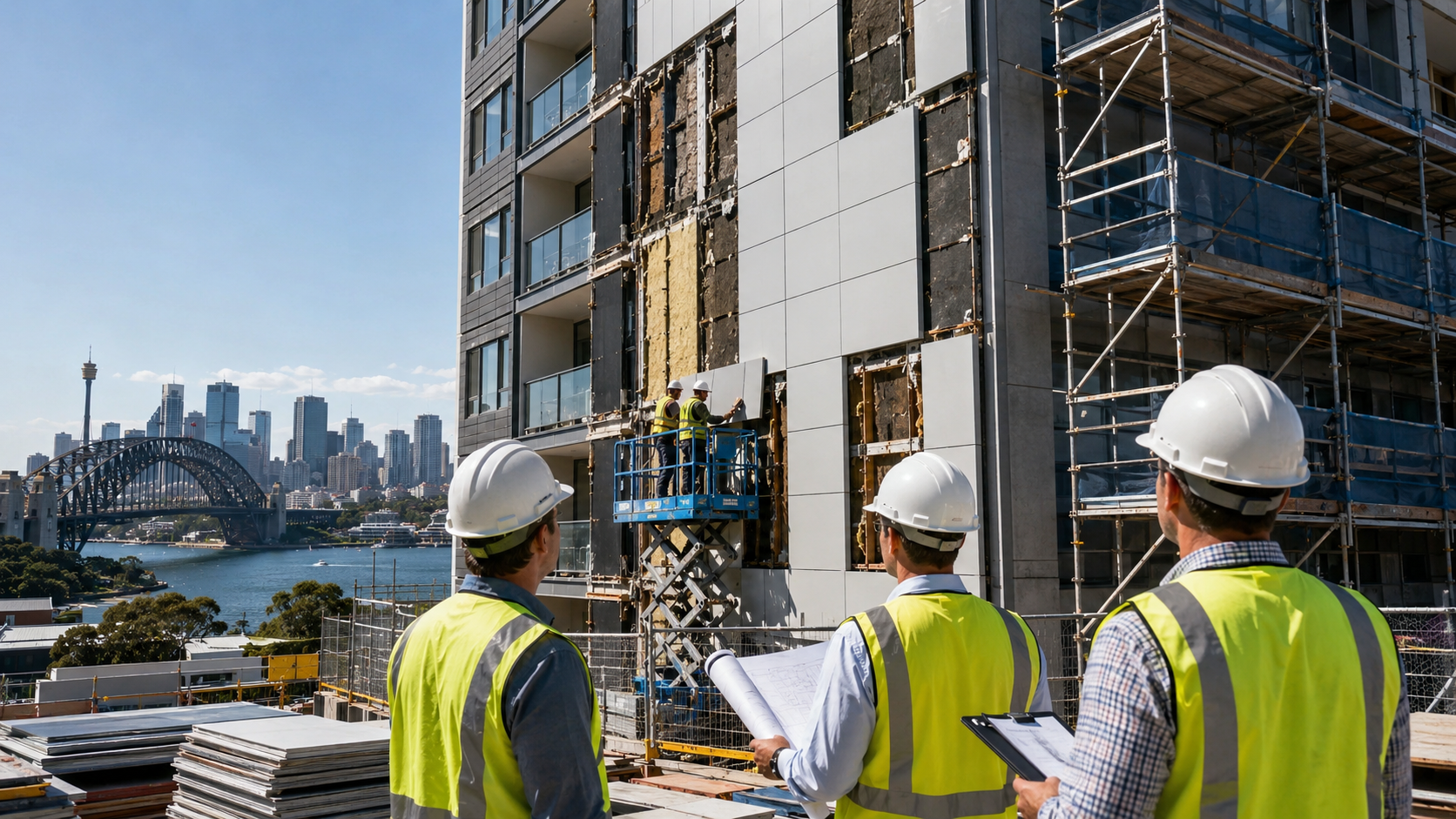
Combustible cladding replacement removes non-compliant façade materials and restores fire-safety compliance on Sydney buildings. NSW regulates the work through a layered compliance regime that owners must satisfy. The Design and Building Practitioners Act treats Class 2 cladding replacement as regulated design work.
The process runs across five defined stages, from façade investigation through to certification. Occupied buildings call for staged delivery that protects residents and operations. Tau Constructions delivers combustible cladding replacement across Sydney as a registered Building Practitioner under NSW Licence 321977C.
Combustible Cladding Replacement Becomes Necessary When Materials Fail NSW Fire-Safety Standards
Combustible cladding replacement becomes necessary when external materials no longer meet NSW fire-safety and National Construction Code requirements. Three triggers usually start the work. A Fire Safety Order from a council or Fire and Rescue NSW compels action. An insurer withdraws or limits cover on the building. A sale or refinance condition forces the issue.
The core problem material is the aluminium composite panel with a polyethylene core. The NSW ban on ACP with a polyethylene core above 30 per cent by mass took effect on 15 August 2018. The risk became clear after the Grenfell Tower fire in London in 2017 and the Lacrosse building fire in Melbourne in 2014. Each event showed how a combustible façade can spread fire across many levels in minutes.
NSW Regulates Combustible Cladding Through a Layered Compliance Regime
NSW regulates combustible cladding through several instruments that building owners must satisfy together. Registration sits at the base of the regime. Owners of buildings of two or more storeys with external combustible cladding must register them in the NSW Cladding Regulation Online Registration System. New buildings must register within four months of first occupancy.
The Combustible Cladding Regulation 2018 sets the registration duty. The exempt-development rules restrict any cladding work that involves combustible material. For eligible Class 2 residential apartment buildings, Project Remediate offers an opt-in pathway. Project Remediate provides ten-year interest-free loans and managed delivery, with Hansen Yuncken as the managing contractor, and the program runs to 2027. Project Remediate is a government program, and owners outside it remediate independently under the same technical rules.
The DBP Act Governs Class 2 Cladding Replacement as Regulated Design Work
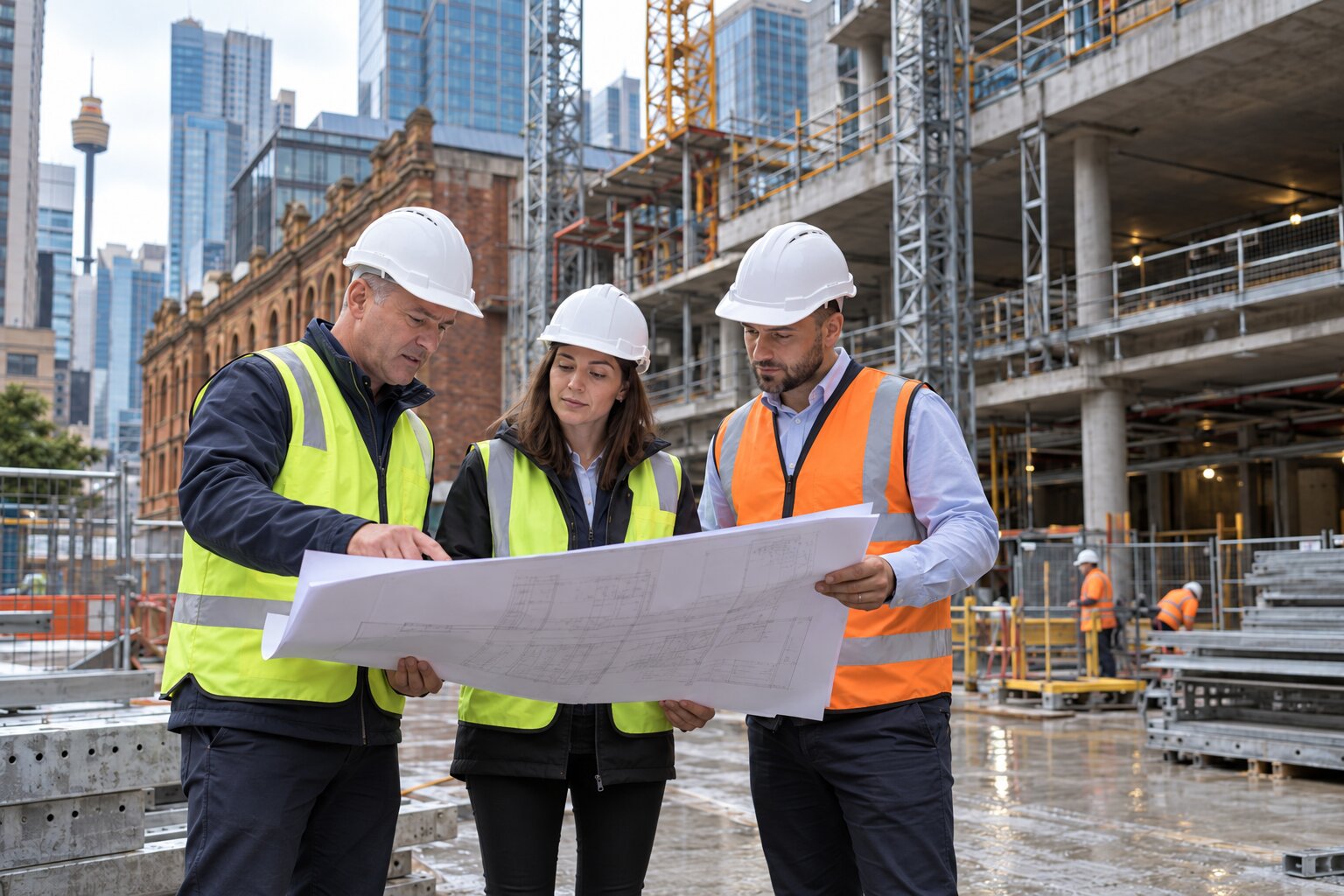
The Design and Building Practitioners Act governs combustible cladding replacement on Class 2 buildings as regulated design work. A registered design practitioner prepares a Construction Issued Regulated Design for the replacement façade. A registered Building Practitioner lodges the designs and the design compliance declaration on the NSW Planning Portal before work starts.
Variations carry strict timing. A variation that affects a building element must be lodged on the Planning Portal within one day of the varied work starting on site. This is the registration depth that separates a registered builder from a general trade. It mirrors the same accountability framework Tau Constructions applies across Class 2 residential construction under the DBP Act.
A further change arrives soon. From 1 July 2026, alteration and repair work on existing Class 3 and 9c buildings falls within the Act. Owners of hotels, aged-care facilities, and student accommodation with cladding should confirm scope against the expanded obligations.
Combustible Cladding Replacement Follows a Defined Five-Stage Process
Combustible cladding replacement follows five defined stages from investigation through to certification. Each stage produces a record that supports the next.
Stage One Establishes the Extent of Combustible Material
Stage one confirms what is installed and where. A façade investigation identifies the cladding system, samples the material, and maps the affected areas. A fire engineer assesses the risk the material presents. Early investigation prevents the strip-and-hope approach that drives cost surprises later.
Stage Two Converts the Investigation Into a Regulated Design
Stage two turns findings into a buildable, compliant scope. The registered design practitioner prepares the regulated design and selects the replacement system. Scope locks here, which surfaces balcony, waterproofing, and substrate issues before contracts are signed.
Stage Three Delivers Removal and Compliant Replacement
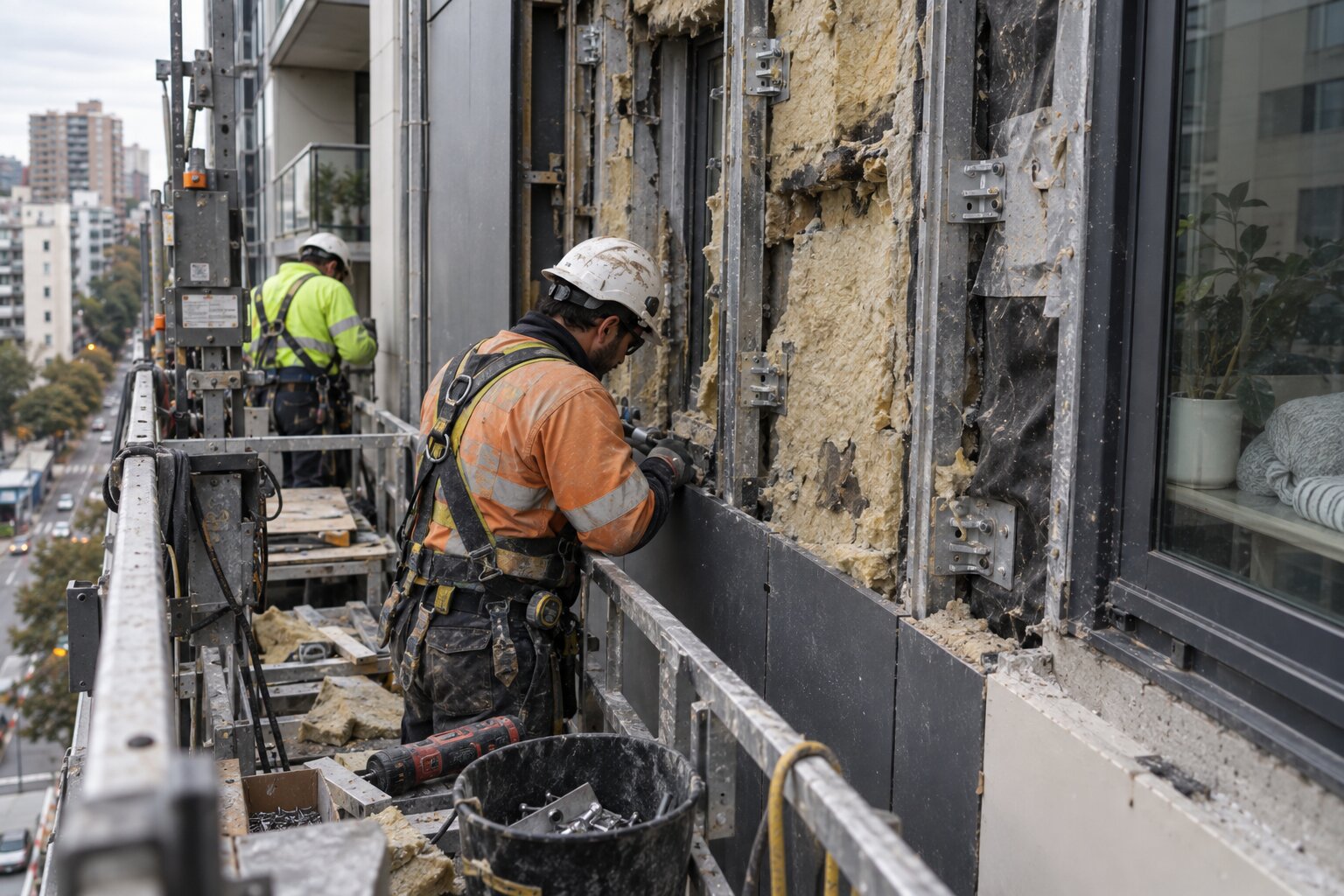
Stage three carries out the physical work. The team removes the non-compliant cladding under controlled site conditions. Installation of the certified replacement system follows, elevation by elevation.
Stage Four Certifies the Façade Against the Declared Design
Stage four proves the work matches the design. The registered Building Practitioner lodges the building compliance declaration. The certifier signs off, and in NSW the outcome is a Remedial Assurance Certificate lodged through the Planning Portal.
Stage Five Completes Documentation and Handover
Stage five closes the project for ongoing compliance. Test certificates, as-built drawings, and installation records form the evidence base. This documentation supports insurance, audits, and future façade decisions. Tau Constructions delivers each stage as part of its building remediation service across Sydney.
Cladding Replacement on Occupied Buildings Requires Staged Delivery
Cladding replacement on occupied buildings requires staged delivery that protects residents and operations. Most affected buildings stay occupied throughout the work. Sequencing matters as much as the material choice.
The team works floor by floor or elevation by elevation to limit disruption. Temporary protection keeps the building secure against water during removal. Clear resident communication and tight safety management keep occupied sites controlled. Live-environment delivery is a core capability for Tau Constructions, drawn from years of occupied commercial and hospitality work.
Compliant Replacement Materials Must Be Verified Non-Combustible to AS 1530.1
Compliant replacement materials must be tested non-combustible to AS 1530.1. The standard applies to the full material, including the core. Façade systems are tested for fire propagation to AS 5113. Impact performance follows NCC Specification C1.8, and resistance to water penetration follows AS/NZS 4284.
Compliant options include solid aluminium, fibre cement, and mineral-core systems. The banned material remains the polyethylene-core ACP. The replacement is a system, not a single panel, so substrate, fixings, cavity, and membrane all form part of the compliant result.
Strata Cladding Replacement Is the Owners Corporation’s Responsibility
Strata cladding replacement is the responsibility of the owners corporation as common property. The external façade is common property under the Strata Schemes Management Act 2015. The owners corporation holds the duty to maintain and rectify it.
Individual lot owners are generally not responsible for external cladding works. Funding comes from special levies or, for eligible Class 2 buildings, from a Project Remediate loan.
Builder Selection Carries Liability Consequences Under NSW Cladding Law
Builder selection carries real liability consequences under NSW cladding law. Section 37 of the DBP Act creates a statutory duty of care owed to current and future owners. The duty cannot be delegated, cannot be contracted out of, and runs for ten years from the Occupation Certificate.
Case law reinforces the builder’s position. In Owners SP92450 v JKN Para 1 Pty Ltd [2023] NSWCA 114, the Court of Appeal placed the onus on the builder to prove a compliant alternative solution existed. A solvent registered Building Practitioner represents genuine recourse, where a phoenix entity leaves owners carrying the cost. This reframes builder selection as a recourse decision, not a price decision.
Tau Constructions Delivers Combustible Cladding Replacement as a Registered Building Practitioner
Tau Constructions delivers combustible cladding replacement across Sydney as a registered Building Practitioner. The company holds NSW Licence 321977C and operates under a director-led delivery model. Director involvement runs end to end, so senior accountability sits on the project rather than off it.
The track record includes completed Combustible Cladding Projects, where non-compliant façade material was removed and replaced with compliant non-combustible systems. The same problem-solving approach extends to why early investigation prevents remediation failures, to concrete cancer and structural defects uncovered during façade works, and to combustible cladding among the common building defects found in NSW.
Frequently Asked Questions
Who is responsible for combustible cladding replacement in NSW?
The owners corporation holds responsibility, because the external façade is common property under the Strata Schemes Management Act 2015. Individual lot owners are generally not responsible for external cladding works.
How do I know if my building has non-compliant cladding?
A façade inspection and cladding audit by a qualified engineer or consultant confirms the material. Aluminium composite panels on buildings constructed before the 2018 ban are a common indicator.
Does all external cladding need to be non-combustible?
Not every application requires it, but external walls that must be non-combustible under the NCC require material tested to AS 1530.1. The presence of cladding does not always mean a building is non-compliant.
Can cladding replacement be done while the building is occupied?
Yes. Staged delivery, temporary protection, and resident communication allow the work to proceed on occupied buildings.
Does cladding replacement require DBP Act compliance in NSW?
Yes for Class 2 buildings. The replacement is regulated design work, so a registered design practitioner must prepare and declare the design before installation begins.
Bring the Façade Problem to Tau Constructions
Combustible cladding replacement restores compliance, protects occupants, and returns a building to an insurable position. The work rewards a registered builder who carries the design pathway, the declarations, and the duty of care from start to finish. Tau Constructions delivers that outcome across Sydney through director-led building remediation.
Contact the Tau Constructions team to discuss a façade assessment and a compliant replacement pathway.